
Our evolution in the management
of Central Retinal Vein Occlusion
José Garcia-Arumi, M. Angel Zapata (Barcelona)
Background and Purpose: Central retinal vein occlusion (CVO) is a retinal vascular condition
that may cause significant ocular morbidity. Radial optic neurotomy and intravitreal triamcinolone
injection have been reported to be effective in treating macular edema in CVO. Edema
recurrence and repeat injections are often necessary with intravitreal triamcinolone. Internal
limiting membrane (ILM) peeling has been performed during vitrectomy in diabetic cystoid
macular edema patients and in CVO patients with contradictory results. The aim of this study
was to compare vitreoretinal surgery with radial optic neurotomy and intravitreal triamcinolone
with or without ILM peeling in the management of macular edema secondary to central or
hemicentral vein occlusion.
Objective: To know if internal limiting membrane peeling in patients with central vein occlusion submitted to vitrectomy,
radial optic neurotomy, and intravitreal triamcinolone improves the visual prognosis at 3 and 6 months.
Methods: Two groups were compared in this study. A prospective study was done in 18 patients with central or hemicentral
vein occlusion and macular oedema, undergoing radial optic neurotomy plus 8 mg of intravitreal triamcinolone acetonide
with ILM peeling. At baseline the following were performed: best-corrected visual acuity (BCVA), biomicroscopic examination
with intraocular pressure, fluorescein angiography, and macular thickness and macular volume (OCT3, fast macular
thickness map). At 1, 3 and 6 months after surgery, visual acuity, intraocular pressure, macular volume and macular thickness
were determined for each patient. We compared the data from these prospective patients with a retrospective group of
16 patients undergoing only radial optic neurotomy, posterior hyaloid dissection and intravitreal injection of 8 mg of triamcinolone
acetonide. Visual acuity, intraocular pressure, macular thickness and macular volume were also studied in this
retrospective group. Inclusion criteria were patients with central or hemicentral vein occlusion and macular oedema, without
a history of corticoid-induced ocular hypertension.
Results: Average age in the ILM peeling group was 61.05 years and mean duration of CRVO prior to surgery was 2 months.
The predominant ocular pathology was open angle glaucoma (6 patients) and the predominant systemic disease was hypertension
(6 patients). At baseline, mean BCVA was LogMAR 1.557 (SD 0.707) and mean macular volume was 13.1 mm3. At
the end of the follow up, mean BCVA improved to LogMAR 0.334 (SD 0.402). Average age in the group without ILM peeling
was 61.2 years and mean duration of CRVO prior to surgery was 2.8 months. Again, open angle glaucoma was the predominant
ocular pathology (5 patients) and hypertension the predominant systemic disease (10 cases) At baseline, mean BCVA
was LogMAR 1.0475 (SD 0.540), with a mean macular volume of 11.5 mm3. At the end of follow up, mean BCVA improved
to LogMAR 0.445 (SD 0.407).
In the outcome comparison between groups, the improvement in BCVA from baseline was greater in the ILM peeling group
than the group without peeling at 3
months (0.44 vs. 0.01; P=.047) and 6
months (1.22 vs. 0.6; P=.035). We did
not find any statistical significance
regarding macular volume between
both groups preoperatively. In the
postoperative period, both groups
showed a marked decrease of the macular
volume after one month (8.6mm3
and 8.0mm3), and this difference was
statistically significant (p< 0.001).
Macular volume remained stable during
the following 6 months.
Ten patients had transient intraocular
hypertension after surgery; 6 of them
had already been treated for openangle
glaucoma before the procedure.
Ocular hypertension persisted in only
2 of these patients at 6 months after
the surgery.
In two patients, both from the group
without ILM peeling, vitreous haemorrhage
occurred 3 months after surgery.
Another three developed nuclear
cataract postoperatively, 1 from the
group without, and 2 from the group
with ILM peeling.
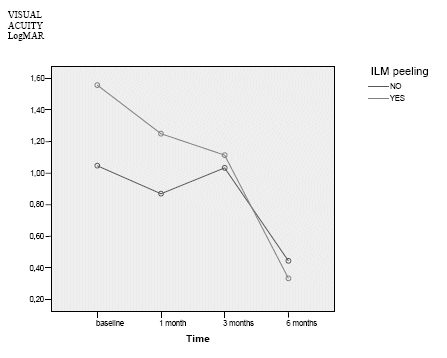
Conclusion: In patients with central or hemicentral retinal vein occlusion, radial optic neurotomy, intravitreal triamcinolone
and ILM peeling resulted in a better 3- and 6-month visual outcome than that achieved with radial optic neurotomy and
intravitreal triamcinolone without ILM peeling. Prospective, randomised, blinded studies are needed to confirm these results.
Prompt diagnosis and identification of complications and new treatment modalities may provide important treatment optionsin the future.